Product
What exactly is being supplied? A complete assembly, or an individual component? Which parts are included, and which are assumed to be reused from the existing installation?
Ask: what is in the box?
Automotive Safety Components · Seat Belt Export
Export Enquiries +91 99206 38354 info@autogleam.in
By the time a consignment is moving, the decisions that determine whether it is right have already been made. This page sets out where those decisions sit — and what a buyer should verify at their own end.
Quality claims are easy to write and hard to substantiate, and in a category as consequential as automotive restraint components, an unsupported claim is worse than no claim at all. So we will be direct about where we stand.
What we do: identify components carefully against the requirement, keep product information consistent from enquiry through to documentation, inspect goods against what was confirmed before they are packed, pack them so they survive international handling, and tell buyers plainly what we know and what we do not.
We do not claim certifications, approvals, test results or ratings on this website. No ISO, ECE, AIS, BIS or other certification is asserted; no OEM approval is asserted; no crash-test result, laboratory test result, government approval or safety rating is asserted. Where documentation exists for a specific product, it is provided against a specific enquiry and can be assessed on its own terms.
Buyers should confirm the approval and conformity requirements that apply to automotive restraint components in their own market, and request the documentation they need as part of the enquiry.
Five questions · Buyer-side
This is the framework we would suggest any buyer applies — to us, or to anyone else they source from. It is deliberately simple, and it catches most of what goes wrong.
What exactly is being supplied? A complete assembly, or an individual component? Which parts are included, and which are assumed to be reused from the existing installation?
Ask: what is in the box?
Where will it be used? Which vehicle, which seating position, which side, and which mounting arrangement? Application suitability is the single most important check in this category.
Ask: is this right for my position?
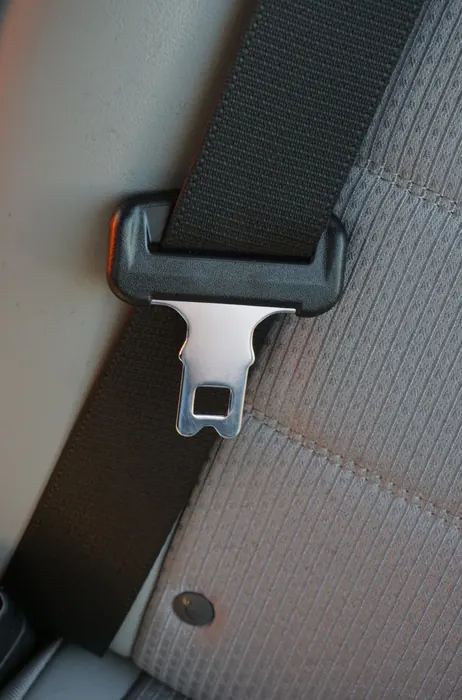
On arrival, check the webbing for cuts, fraying, contamination and hard creasing; check that the latch plate engages and releases cleanly in the receiver; check hardware for damage sustained in transit.
Ask: did it arrive as described?
What information does your own market, customer or process require? Establish that at the enquiry stage, so what accompanies the goods matches what you actually need.
Ask: what has to travel with it?
International movement involves repeated handling, stacking and changes in temperature and humidity. Packaging has to keep webbing clean and uncreased and shield buckles, latch plates and hardware from impact and abrasion.
Ask: will it survive the journey?
Any component that a buyer is not satisfied with on inspection should be raised before it is fitted. Restraint components are not a sensible place to accept uncertainty.
Eight areas of attention
01
What is described in the enquiry, confirmed in the order, packed in the carton and written on the paperwork should all be the same thing. Most disputes in export supply trace back to one of those four drifting from the others.
02
Identifying the belt type, seating position, orientation and mounting arrangement precisely, and re-confirming the identification with the buyer before anything is committed.
03
Understanding how these components are made — how webbing is woven and finished, how latch plates and buckles are formed and assembled — so that a product can be described accurately and assessed sensibly. We are an exporter, not a manufacturer, and we describe products on that basis.
04
Checking goods against the confirmed requirement before they are packed: the right item, the right quantity, engaging and releasing correctly, webbing free of visible damage or contamination, hardware intact.
05
Packing chosen for the journey rather than the shelf. Webbing kept clean and free of hard creases, moulded parts and metal hardware protected from impact and abrasion, and the package able to take stacking and repeated handling.
06
Paperwork that describes the goods accurately and consistently. Where a buyer needs specific information for their own import or onward supply process, that requirement is established during the enquiry rather than discovered afterwards.
07
Confirming that a component is appropriate for the position and vehicle described. Where suitability cannot be established from the information available, we say so rather than supplying something approximate.
08
Keeping the buyer informed — including when the news is a delay or a limitation. A buyer told early can adjust; a buyer told late cannot.
Describe the component and the application, and we will answer each one directly — including where the honest answer is that something cannot be confirmed.